Week of the 01/05/2025 - #2
Contents
tech
- Dittytoy: The Code-Driven Music Playground for the Web.
- Some Apple II resources
- SEGA Genesis
- REST in Neovim
- Random links from Hacker newsletter
- More on Dithering
- Gameboy Development Resources
- Gamedev Resources
Dittytoy: The Code-Driven Music Playground for the Web.
From the website: “Dittytoy is a platform for creating code-driven music using JavaScript. Instead of arranging samples on a timeline, you write code that generates sound. This lets you create music that evolves, responds to parameters, or never repeats. Everything runs in your browser using the Web Audio API “
- dittytoy website - Main website
- documentation - Site documentation
- DT303 - TB303-like synth. Really cool. Want to sample it into my KO II and jam with it.
- Philip Glass ‘Opening’ - A reproduction of Philip Glass’s piece “Opening”, from “Glassworks”
- Lots of more example in the site
Some Apple II resources
- Emulation Evaluation 2024 - “If you want to use an Apple II software on a modern computer, then you need an emulator: a virtual Apple II, recreated in software. Its hardware components, from the 6502 on up, are mimicked, as part of an application written for a modern machine. Disks are represented as “image files” containing their data, and, while running in an emulator, Apple II software has no awareness that it’s not running on the real thing.”
- A2osX - Multi Tasking OS for Apple IIe //c IIgs
SEGA Genesis
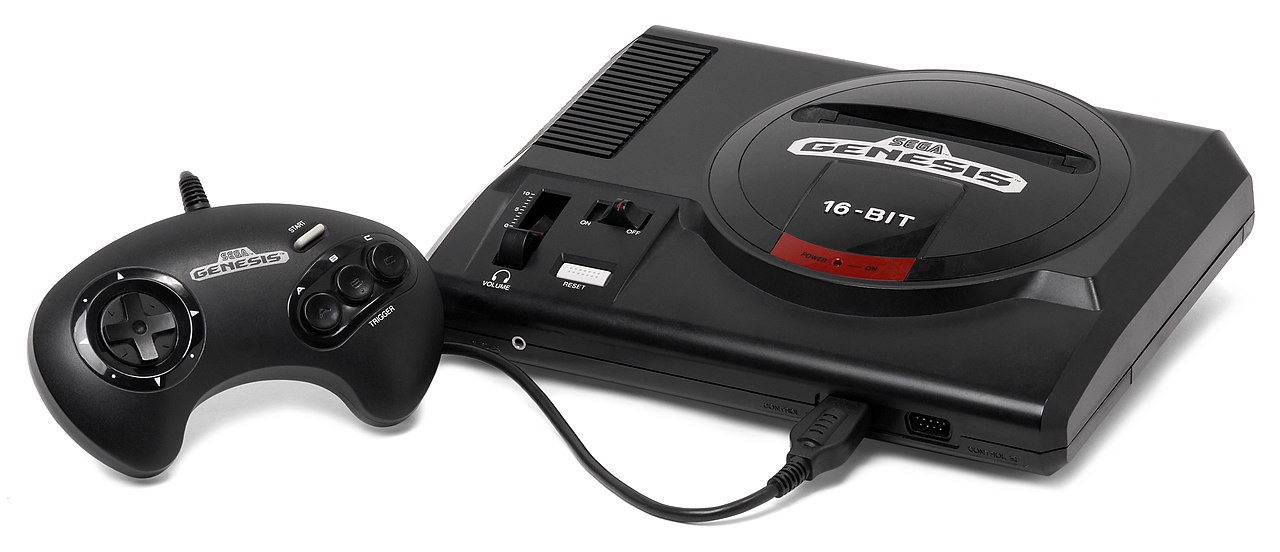
I have been gifted a SEGA Geneis game console so I’m excited to write some code for it. The exact model is the #MK-1601. Aparentely there are a couple of versions, I have the “Sonic” version. From an article which talks about the different variations: “This version looks the same as the original but SEGA added the License Screen that would pop-up before each game, adding about 3-4 seconds to your initial wait time to get to the gaming. Also, from this revision on SEGA installed a “Lock-Out” chip for regional restrictions. The FCC-ID code for this unit is: FJ8USASEGA.”
In preparation for my next projects here are some resources on coding for the SEGA Genesis:
- SGDK - A free and open development kit for the Sega Mega Drive. “SGDK is a free development kit allowing development of software in C language for the Sega Mega Drive. It contains the development library itself (with the code sources) and some custom tools used to compile resources. SGDK uses the GCC compiler (m68k-elf target) and the libgcc to generate a ROM image. Binaries (GCC 13.2) are provided for Windows OS for convenience, but you need to install it by yourself for other operating systems (more infos about it in HELP AND SUPPORT section). Note that SGDK also requires Java (custom tools require it), so you need to have Java installed on your system.”
- SGDK Helper - Helper script for working with SGDK on Linux. This helper is really cool because you can develop having all your tools inside a Docker container. Probably will go with this option.
- Docker SGDK - Docker container to build SGDK stuff
- Awesome Mega Drive Development - A curated list of Sega Mega Drive development resources
- Mega Cat Studios Blog - A cool blog with several interesting articles as they are SEGA Genesis developers.
- 4000 in 1 MD V3 Pro Card With 8GB TF Card MD Game Card For SEGA Genesis Mega Drive Master System Game Console- I bought this card to use on my SEGA Genesis to be able to upload my homebrew games.
From the site these are some interesting articles:
- OPTIMIZING 16BIT PIXEL ART FOR CLASSIC CONSOLES
- CREATING MUSIC AND SOUND FOR THE SEGA GENESIS/MEGA-DRIVE: A PRIMER FOR USING THE VGM MUSIC MAKER
- MAP FORMATS AND IMPORTING LEVELS FOR GENESIS
- PUSHING THE SEGA GENESIS TO ITS LIMITS
- Sonic 3D’s Impossibly Compressed Logo FMV - How’s it done?
REST in Neovim
As most developers now a days I need to test REST APIs. Most developers use Postman. Personally it annoys me to have to log in to an application to do this. I prefer to use CLI tools. As a vim user I learned about the rest.nvim pluing for Neovim. You basically create a simple .http file for where you can store your server requests in text format. For more information on the http format see this page on the IntelliJ editor page.
- Pluing page - rest.nvim - GH page: “A very fast, powerful, extensible and asynchronous Neovim HTTP client written in Lua.”
Random links from Hacker newsletter
Every Friday I receive in my inbox the latest news from the Hacker newletter. Usually there are many interesting articles to read. Here is a selection for recent ones I would like to re-visit:
- The Linux Boot Process: From Power Button to Kernel - “You press the power button. A second later a wall of text scrolls by, or a logo fades in, and eventually Linux appears. What happens in between is not magic. It is a careful handshake between tiny programs and a very literal CPU. This part follows that handshake until the very first line of C code inside the Linux kernel runs.”
- UV Python Virtual environment system - It’s 2025. Does installing Python, managing virtual environments, and synchronizing dependencies between your colleagues really have to be so difficult? Well… no! A brilliant new tool called uv came out recently that revolutionizes how easy installing and using Python can be.
- UV documentation - An extremely fast Python package and project manager, written in Rust.
- Things you can do with diodes - Paying homage to the component we usually don’t think about.
- Our Quantum Echoes algorithm is a big step toward real-world applications for quantum computing - Our Willow quantum chip demonstrates the first-ever algorithm to achieve verifiable quantum advantage on hardware.
- eza - A modern alternative to ls. See eza rocks website.
- zoxide - A smarter cd command. Supports all major shells.
More on Dithering

- Adventures in Dithering - I love dithering style. This is a nice article con dithering experiments
- Ditherpunk — The article I wish I had about monochrome image dithering - I always loved the visual aesthetic of dithering but never knew how it’s done. So I did some research. This article may contain traces of nostalgia and none of Lena.
- Image Dithering: Eleven Algorithms and Source Code
Gameboy Development Resources
I’m currently working on a Gameboy game. Here are some resources that I found useful:
- Github profile for bbbbbr - This developer has a lot of interesting GB resources.
- A puzzle game for the Game Boy Color (CGB), Analogue Pocket (AP) and Game Gear(GG). Build pets in all shapes and sizes, keep the board clear.
- GameBoy-Flash-Carts - List of Game Boy Flash Cart Vendors and Options
- Canyon Racer - Top Down Racing Demo for the Game Boy (and Mega Duck) with a Vertical Parallax Effect
- gb-wordyl - A word game for the Nintendo Game Boy / Color, Analogue Pocket, Mega Duck
- gameboy_qrcode - Dynamically generate and show arbitrary QR codes at Runtime(!) on the Game Boy, built with GBDK-2020 (not pre-rendered ones)
- More than you wanted to know about how Game Boy cartridges work - Everything you need to know to create your own GB cartridges
- BSR1 Chiptune Music Tool - “BSR1 is a live sampling device similar to Ableton Push for the Nintendo Gameboy. It can play a pre-composed beat overlaid with samples triggered using the Gameboy’s buttons. You can use it as a primary live performance tool, a companion to LSDj, or a drum machine. You can also assign buttons to change the stereo on certain channels, mute channels or mute everything. Fully configurable sound board with 81 live slots and 140 different samples and effects (stereo change in real time, mute channels, etc).”
- Drawing Text in Game boy Games
- Drawing Advanced Dialogue in GBDK. - Repo with code
- Adding Variable Width Fonts to your GBDK 2020 Game - How to use the VFA library in GBDK-2020.
- Playing Music in Game Boy Games with Huge Driver
- Toxa - Creator of GBDK-2020
- CrossZGB - Fork of ZGB: “Game engine for the Nintento Game Boy / Nintento Game Boy Color / Analogue Pocket / Mega Duck / Sega Master System / Sega Game Gear”
- Game Boy Graphics & How To Code Them - YT Video - A short YT video with the basics of Gameboy graphics.
- Labyrinth of the Dragon (GBC) - Source code for an 8-bit Adventure RPG with D&D Monsters!. Game page on itchi.io.
Gamedev Resources
Since developing on the Gameboy is slow I find it useful to develop on Tic-80 / Pico 8 to test game ideas and once I’m happy with them I move them to the Gameboy. Since I don’t have too much experience as a game developer I found some useful resources on the web on how to develop with these tools. My favorite so far is this:
- Lazy Devs YouTube channel - “Lazy Devs Academy is a channel dedicated to newcomer-friendly Game Development tutorials. We take you step by step trough your first simple projects and make sure to focus on fun and creativity so you can start making your own games soon.”
- Pico-8 Tutorial - Advanced Shmup - This is an awesome tutorial on creating a Shmup (Shoot them up) game in Pico8. I learned a ton of things from these videos. Highly recommended.
- Pico-8 Basic Shmup Tutorial / source code - This is a repository of the Lazy Devs Academy Pico-8 Hero Basic Shmup Tutorial.
- How to make your game run at 60fps